


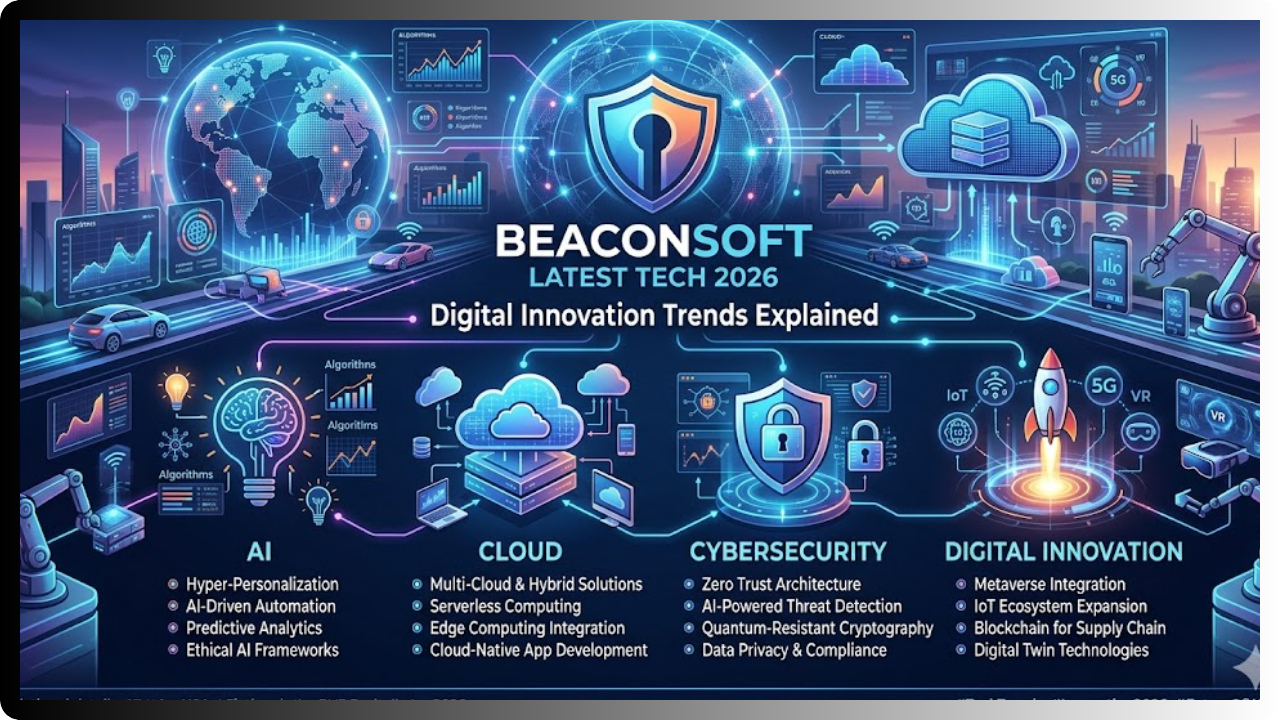
The popularity of #beaconsoft latest tech continues growing as businesses and technology enthusiasts search for innovative digital solutions shaping the future of modern industries. In 2026, digital transformation has become essential for companies aiming to improve operational efficiency, customer engagement, and long-term scalability. Technologies such as artificial intelligence, cloud computing, cybersecurity, and data analytics are now deeply integrated into business ecosystems worldwide. Organizations increasingly depend on intelligent systems to automate processes, secure digital infrastructure, and improve decision-making capabilities. The rapid evolution of modern technology is creating new opportunities for businesses to remain competitive in changing markets. As a result, #beaconsoft latest tech has become a widely discussed topic in the digital innovation landscape. This transformation is also influencing global digital economies at a faster pace than ever before. Businesses are rapidly adopting smart technologies to stay relevant in competitive industries. Consumer expectations are also driving innovation across multiple sectors. Overall, digital ecosystems are becoming more intelligent, connected, and data-driven.
Who Is Behind #Beaconsoft Latest Tech Concept
The concept behind #beaconsoft latest tech is not tied to a single person or organization but represents a broader digital transformation ecosystem. It reflects how modern industries adopt emerging technologies such as AI, cloud systems, cybersecurity frameworks, and automation tools. Technology companies, developers, and digital platforms collectively contribute to shaping this evolving landscape. The focus is on improving efficiency, scalability, and intelligent decision-making through advanced systems. It highlights how digital innovation is reshaping global industries. This concept continues to grow as more organizations adopt smart technologies for business transformation. It is also influenced by continuous research and development in the tech sector. Governments and enterprises are investing heavily in digital infrastructure to support innovation. Collaboration between industries is accelerating technological progress. This makes the ecosystem highly dynamic and constantly evolving.
Emerging AI Innovations in #Beaconsoft Latest Tech
Artificial intelligence is rapidly evolving within #beaconsoft latest tech as businesses adopt smarter algorithms, generative AI models, and advanced predictive systems. These innovations are improving automation, customer engagement, and decision-making across industries. AI-driven platforms are also enhancing personalization and operational efficiency. Companies are using AI to analyze large datasets in real time for better strategic planning. This continuous innovation is making digital ecosystems more intelligent and adaptive. AI is also enabling self-learning systems that continuously improve performance. Businesses are integrating AI into core workflows for faster execution. It is helping reduce operational costs across multiple sectors. AI-driven insights are becoming essential for competitive advantage. The future of AI is closely tied to digital transformation growth.
Role of Big Data in Modern Digital Transformation
Big data plays a crucial role in #beaconsoft latest tech by enabling organizations to process and analyze massive volumes of structured and unstructured information. Businesses rely on data-driven insights to understand customer behavior and market trends. Advanced analytics tools help improve decision-making accuracy and business forecasting. Real-time data processing is also helping companies respond quickly to market changes. This is making data a core asset in digital transformation strategies. Big data also improves predictive accuracy in business planning. It helps organizations identify hidden patterns in customer behavior. Companies can optimize operations using data intelligence. It strengthens strategic planning across industries. Data-driven systems are becoming the backbone of modern enterprises. Big data also supports AI model training for smarter automation systems. It enhances personalization across digital platforms.
Cloud Security Advancements and Data Protection
Cloud security is becoming a major focus within #beaconsoft latest tech as organizations move more sensitive operations to digital platforms. Advanced encryption, multi-layer authentication, and AI-based monitoring systems are improving data protection. Businesses are investing in secure cloud infrastructures to reduce cyber risks. These technologies help ensure compliance with global security standards. Strong cloud protection systems are now essential for digital business continuity. Cloud security also supports faster threat detection and response. It reduces risks of unauthorized data access. Organizations are strengthening privacy controls in cloud environments. Security automation is improving system reliability. This ensures safer digital transformation at scale. Cloud environments are also becoming more resilient against advanced cyber threats. Continuous monitoring improves overall system trust and stability.
Smart Automation in Industrial Systems
Smart automation is transforming industries under #beaconsoft latest tech by reducing manual processes and improving operational efficiency. Automated systems are now widely used in manufacturing, logistics, healthcare, and finance sectors. These systems increase productivity while minimizing human error. Robotics and AI integration are further enhancing industrial performance. This trend is creating faster and more efficient production environments worldwide. Automation also improves workplace safety and consistency. It enables continuous 24/7 operations without interruption. Businesses can scale production more effectively. Smart systems reduce overall operational costs. Industrial automation is becoming a global standard. It also improves real-time monitoring of industrial operations. Companies are achieving higher output with fewer resources.
Edge Computing and Real-Time Processing
Edge computing is becoming a vital part of #beaconsoft latest tech by enabling faster data processing closer to the source of generation. This reduces latency and improves real-time decision-making capabilities. Businesses use edge computing in IoT devices, smart cities, and industrial automation systems. It also supports faster analytics and reduces dependency on centralized servers. This technology is improving speed, efficiency, and system responsiveness. Edge computing also enhances data security by limiting data transfer. It supports offline processing in remote locations. Organizations gain faster insights from local data processing. It improves system reliability and performance. This is essential for real-time digital operations. Edge computing also reduces bandwidth usage significantly. It strengthens the performance of connected smart systems.
Digital Innovation and Future Technology Trends
Digital innovation continues to expand within #beaconsoft latest tech as new technologies like quantum computing, blockchain, and extended reality emerge. These advancements are reshaping how businesses operate and interact with digital systems. Companies are investing heavily in next-generation technologies to stay competitive. Innovation cycles are becoming faster and more disruptive. This is driving the future of fully connected and intelligent digital ecosystems. Digital innovation is also improving global connectivity. It enables more immersive user experiences. Businesses are shifting toward fully digital operations. Technology convergence is accelerating industry transformation. The future will be driven by continuous innovation and automation. Digital ecosystems are becoming more integrated and intelligent. These technologies are redefining global digital infrastructure.
Artificial Intelligence and Smart Automation
How AI Is Transforming Digital Industries
Artificial intelligence remains one of the most influential aspects of #beaconsoft latest tech because AI-powered systems improve efficiency across multiple industries. Businesses now use machine learning and predictive analytics to automate workflows, personalize customer experiences, and analyze massive datasets in real time. AI technologies also support intelligent virtual assistants, recommendation engines, and automated customer service platforms. These innovations reduce manual workloads while increasing operational accuracy and productivity. Organizations increasingly depend on AI-driven insights to improve strategic planning and business performance. AI is also helping industries reduce costs through smart decision systems and automated decision-making tools. It enables faster data interpretation for better business forecasting and planning. Many organizations are now integrating AI into core operations to stay competitive in digital markets. This transformation is creating a more intelligent and responsive business environment globally.
Growth of Machine Learning and Automation Systems
Machine learning technologies are rapidly transforming modern workplaces by enabling systems to improve performance based on collected data and behavioral patterns. Automated software solutions now handle repetitive administrative tasks, inventory management, and operational monitoring processes. Businesses use automation tools to increase productivity while minimizing human error and reducing operational expenses. Intelligent algorithms also help companies deliver more personalized digital experiences for customers. Automation technologies improve efficiency across industries including finance, logistics, healthcare, and e-commerce. Machine learning also enhances predictive accuracy in business forecasting models. It allows systems to adapt automatically without human intervention over time. Companies are increasingly relying on AI-driven automation to scale operations faster. This shift is redefining how digital workflows are managed in modern industries.
Cloud Computing and Scalable Digital Infrastructure
Importance of Cloud Technology in Modern Business
Cloud computing has become an essential part of #beaconsoft latest tech because businesses require secure and scalable infrastructure to support digital operations. Cloud-based systems allow organizations to store, manage, and access data remotely without depending on traditional hardware infrastructure. This flexibility improves collaboration, remote work capabilities, and real-time information sharing across teams. Businesses also benefit from reduced maintenance costs and improved operational scalability through cloud platforms. Cloud systems also enhance disaster recovery and data backup efficiency for organizations. They provide faster deployment of digital services across global networks. Businesses can easily scale resources based on demand fluctuations. Cloud adoption is now a key driver of digital transformation strategies worldwide.
Hybrid Cloud Solutions and Operational Flexibility
Hybrid cloud systems combine private and public cloud environments to provide greater flexibility and stronger security for businesses. Organizations prefer hybrid infrastructure because it allows sensitive information to remain protected while maintaining scalable computing capabilities. These systems improve data management, disaster recovery planning, and operational efficiency across departments. Businesses can quickly adjust digital resources depending on market demand and organizational needs. Hybrid cloud solutions also reduce dependency on single infrastructure providers. They improve system reliability and uptime across digital platforms. Organizations gain better control over data distribution and access management. This model is becoming a preferred choice for enterprise-level IT systems globally.
Cybersecurity and Digital Protection Systems
Rising Importance of Cybersecurity Technologies
Cybersecurity plays a critical role in #beaconsoft latest tech because digital threats continue increasing across connected online environments. Businesses face risks related to ransomware attacks, phishing scams, data breaches, and unauthorized access to sensitive information. Modern cybersecurity solutions use artificial intelligence and advanced analytics to identify suspicious activities in real time. Companies are also implementing multi-factor authentication systems and encrypted communication technologies. Cybersecurity also helps maintain customer trust and brand reputation in digital markets. It ensures compliance with global data protection regulations. Organizations are investing more in proactive security strategies. This has made cybersecurity a top priority for all digital businesses. Strong security frameworks also help reduce financial losses caused by cyber incidents.
AI-Powered Threat Detection and Risk Management
Artificial intelligence significantly improves cybersecurity performance by identifying abnormal network behavior and potential threats faster than traditional systems. AI-powered monitoring tools analyze massive amounts of data to detect security risks before they cause serious damage. Machine learning algorithms continuously adapt to new attack patterns and evolving cyber threats. These intelligent defense systems improve overall digital resilience and security efficiency. AI also reduces response time during cyber incidents significantly. It enables predictive threat analysis for stronger protection strategies. Security systems are becoming more autonomous and self-learning. This advancement is reshaping how organizations defend against cyberattacks. AI also helps automate incident response and strengthens fraud prevention systems.
Internet of Things and Connected Smart Systems
Expansion of IoT in Modern Digital Ecosystems
The Internet of Things continues growing as connected devices become increasingly important within modern digital infrastructure. Smart technologies now connect homes, businesses, industrial equipment, and transportation systems through internet-based communication networks. IoT systems collect real-time information that helps organizations improve operational efficiency and decision-making capabilities. IoT also supports automation in industrial and smart city environments. It enables seamless communication between physical and digital systems. Businesses can track assets more efficiently using IoT devices. The technology is also improving energy management systems globally. This interconnected ecosystem is expanding rapidly across industries. IoT is also enabling predictive maintenance and reducing system downtime.
Real-Time Data Processing and Smart Connectivity
Connected smart devices generate large amounts of real-time data that businesses use to improve productivity and operational visibility. Organizations can monitor equipment performance remotely and predict technical failures before disruptions occur. IoT-enabled systems improve supply chain management and inventory accuracy across multiple industries. Real-time analytics also helps companies respond more quickly to customer demands and market changes. Data processing speed is becoming a critical factor in operational success. Smart connectivity improves coordination between global business networks. It enhances automation in industrial systems significantly. These advancements are making businesses more data-driven and efficient. Edge computing is further improving real-time processing capabilities.
Data Analytics and Business Intelligence
Role of Data Analytics in Digital Transformation
Data analytics remains one of the most valuable components of #beaconsoft latest tech because businesses depend on accurate information to improve strategic planning and customer engagement. Advanced analytics platforms process large datasets to identify market trends, customer preferences, and operational inefficiencies. Organizations use business intelligence systems to improve marketing strategies and increase profitability. Data analytics also helps reduce operational risks through better insights. It supports real-time business monitoring and reporting. Companies can optimize decision-making using data-driven strategies. Analytics tools are becoming more intelligent and automated. This is driving smarter business operations globally. Data visualization tools also simplify complex business insights.
Predictive Analytics and Consumer Insights
Predictive analytics technologies help businesses forecast future outcomes by analyzing historical and real-time information. Companies use predictive models to improve customer retention, inventory planning, and financial forecasting strategies. Intelligent algorithms analyze consumer behavior patterns to deliver personalized digital experiences. Predictive systems also help identify future market opportunities. Businesses can anticipate demand changes more accurately. This improves resource allocation and planning efficiency. Data-driven forecasting is becoming essential for business success. It strengthens competitive advantage in digital markets. Predictive analytics also reduces business risks through early insights.
Future of #Beaconsoft Latest Tech in 2026
Emerging Technologies Shaping the Future
Several emerging technologies are expected to further strengthen #beaconsoft latest tech as digital innovation continues accelerating worldwide. Quantum computing, robotics, virtual reality, augmented reality, and blockchain systems are becoming increasingly important in modern industries. These technologies are expected to redefine automation, security, and data processing capabilities. Emerging tools are also improving human-computer interaction. They enable faster and smarter digital environments. Businesses are investing heavily in next-generation technologies. Innovation cycles are becoming shorter and more advanced. This will reshape global digital ecosystems significantly. These advancements are also improving global communication systems. They support more immersive digital experiences. Future workplaces will rely heavily on intelligent automation tools. These innovations will also increase productivity across multiple sectors worldwide.
Long-Term Impact on Businesses and Society
The long-term impact of modern technology will continue reshaping industries, communication systems, and digital experiences. Businesses adopting advanced technologies can improve productivity, strengthen competitiveness, and enhance customer engagement. Intelligent systems will continue driving automation and innovation across global markets. Society will also experience improved digital accessibility and connectivity. New job roles will emerge due to technological advancement. Organizations will rely more on data-driven ecosystems. Technology will continue influencing economic growth worldwide. This transformation will define the future of digital civilization. Digital skills will become more important in the workforce. Automation will change traditional job structures. Innovation will continue creating new business opportunities globally. These developments will also encourage stronger global digital collaboration and smarter economic systems.
FAQs
What is #beaconsoft latest tech?
It refers to modern digital innovations including AI, cloud computing, cybersecurity, IoT, and data analytics.
Why is #beaconsoft latest tech important in 2026?
It is important because it improves efficiency, security, and digital transformation across industries.
How does AI help businesses?
AI automates tasks, analyzes data, and improves decision-making and customer experience.
Which industries use these technologies most?
Finance, healthcare, retail, logistics, education, and manufacturing industries benefit the most.
Is cloud computing part of it?
Yes, cloud computing is a core part of modern digital infrastructure and scalability.
Final Thought
The evolution of #beaconsoft latest tech is reshaping how industries operate, communicate, and grow in the digital era. With advancements in AI, cloud computing, cybersecurity, IoT, and analytics, businesses are becoming more intelligent and efficient. Organizations that adopt these technologies gain stronger competitiveness, better security, and improved customer engagement. As innovation continues accelerating, digital transformation will remain a key driver of global economic growth. The future will be defined by smarter systems, automation, and fully connected digital ecosystems. This shift is also creating new opportunities for startups and established enterprises alike. Continuous innovation will play a key role in maintaining global competitiveness. Human and machine collaboration will become more advanced in everyday operations. Ultimately, digital intelligence will shape the next generation of global industries. These advancements will also enhance global connectivity and operational transparency. The ongoing digital shift will redefine how value is created across every sector.
